Free design software for prosthetic sockets and orthotic insoles. The part comes from our own print farm in the region.
No licenceNo printer in the clinicMade in the Netherlands
Omid Ghazi, Reza Khodakarim, Sajjad SeyedzadehPre-seed round, Eindhoven, October 2026
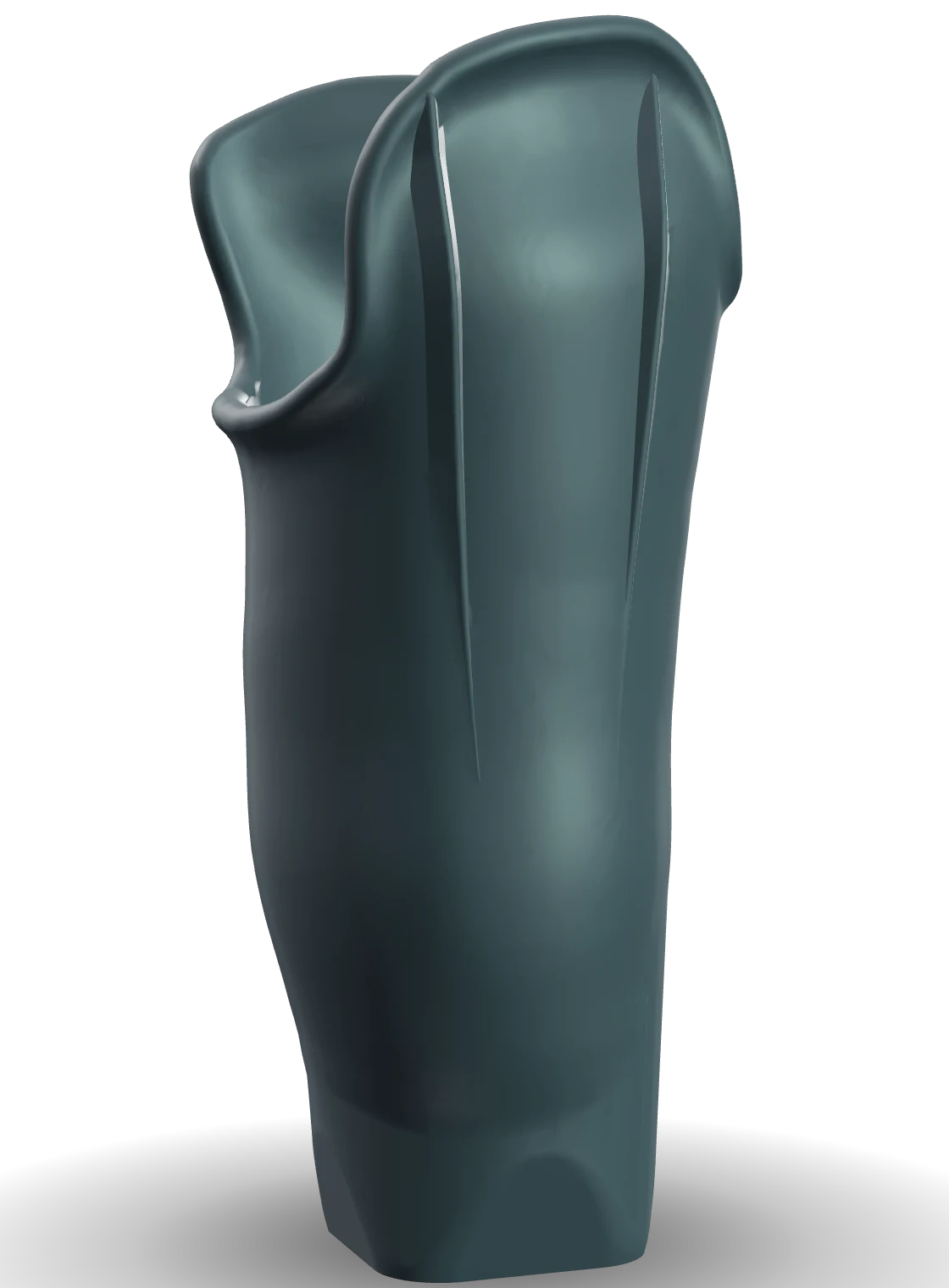
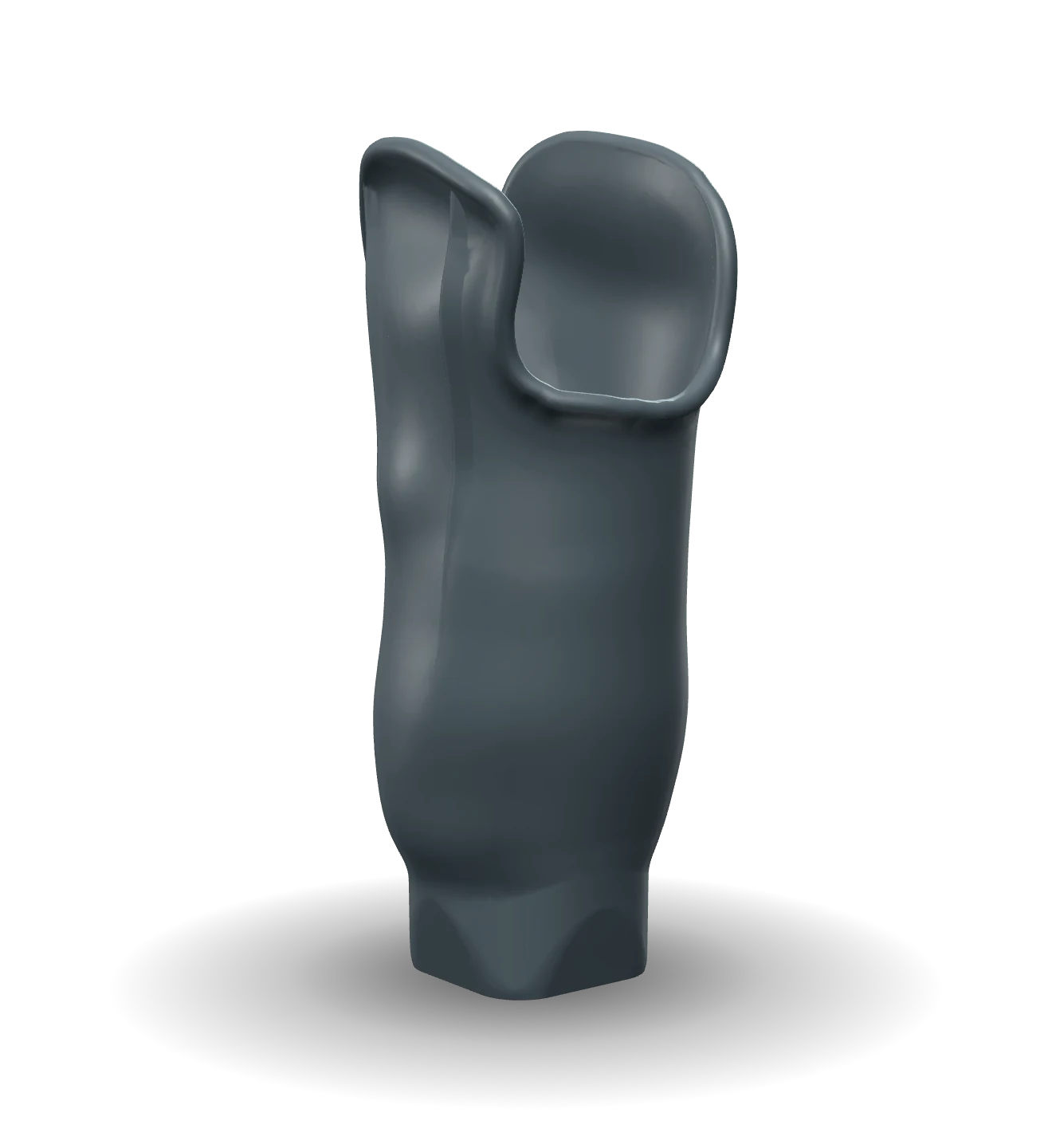
Drag to turnA production socket from our farm534.5 cm³median wall 5.1 mmone watertight body
A socket still starts with plaster.
Cast the limbPlaster bandage, by hand, in the clinic
Fill the castThe positive model the socket is made on
Rectify by handAbout a day of a technician's work
Laminate, trim and finishThen the patient comes back to try it
If the fit is wrong, start againA second version costs the same, so it is often not made
2-3days
elapsed for the first version of a socket
6-8hours
of technician time for every socket
€430-590
of workshop time and material, at the sector rate of €54.50 an hour
Insoles have the opposite problem: volume. A practice fits pairs every week and chooses between a laboratory's catalogue shape and a €25,000 printer of its own.
Every option a clinic has today solves half the problem.
A CAD licence
A printer of your own
A central lab
Avesta
Up front
Thousands of euros a year
About €25,000, plus material
Nothing
Nothing
Who designs
You
You, in separate software
The lab, often from a catalogue shape
You, in free software in your language
Who makes it
A manufacturer you find
Your team, running the machine
The lab, at its own pace
We do, on our own farm nearby
Per part
The manufacturer's price
Material, machine time and failed prints
The lab's price
From €45 an insole pair, €120 a check socket, €340 a definitive socket
Delivery
Depends on the manufacturer
When the team has time
Days to weeks
Insoles in under 3 working days, sockets in under 5
Typical market prices in the Netherlands, not quotes. Licences: LutraCAD, Qwadra, Spentys. Printers: PodoPrinter. Laboratories: Materialise Phits, FootFacilities, the milling labs.
Design for free. Pay for the part you take.
We make it.
Approve the design and order the part. We print, finish, check and ship it. The clinic pays for the part and nothing for the design.
Approved in the clinic, in Avesta Studio
Priced within one working day
Printed at the farm nearest the clinic
Insoles delivered in under 3 working days, sockets in under 5
You make it.
Download the STL, the print project and the report, and have the part made wherever you like. The clinic pays a download fee and nothing else.
The plan assumes no download revenue. The software is the door, not the business.
No licenceNo seat feeNo subscriptionEvery revision free
Part
Made by us
Volume price
Download
Insole pairTPU 95A, engraved
€55
€50 from 10 a month€45 from 30 a month
€9
Check socketfor the fitting trial
€120
One price
€19
Definitive socketfoamed carbon-fibre polyamide
€390
€340 from 5 a month
€49
Prices exclude VAT. Shipping within the Netherlands is included.
Next: a cranial remoulding helmet for infants, added after its clinical test, expected by December 2026.
A free month to try it.Set up in an afternoon; the first parts are free.
From scan to print. Every value is the practitioner's.
Scan input
The limb, checked and measured.
The scan is cleaned, aligned and measured. A file the studio cannot design on is refused, and it says why. The practitioner signs the step.
Cavity volume
2,122cm³
Height
279mm
Trimline
The rim, drawn on the limb.
On this socket the rim is measured every 2 degrees. The studio's house trimline is a cut like this one, measured off one of our production sockets.
Rim points
180
Popliteal cut
92.1mm
Wall
Typed by the prosthetist, measured by us.
This socket was asked for a 4 mm wall, 6 mm at the distal end. The studio never proposes a wall thickness: it measures the wall it built at every vertex, and says "not measured" rather than guess.
Median wall
5.13mm
5th percentile
3.98mm
Block
A block to bolt to.
The distal end is solid: a plate with rounded corners that widens as it rises and turns round, a pocket for a steel insert at each corner, and a hole in the centre. Measured on this socket.
Plate
70.1mm
Pockets on a square of
36mm
Inserts
Four steel inserts.
A stainless steel insert screws into each pocket: M12 outside, where it grips the printed wall, and M6 inside, where the adapter's screws go. The screws thread into steel, never into the print.
Outside
M12
Inside
M6
Adapter
The adapter, screwed on.
A four-hole pyramid adapter sits flat on the plate over the inserts, held by four stainless M6 screws. Its pyramid is where the pylon and the foot join, and where the alignment is set.
Screws
4 × M6
Adapter
4-hole
Print export
One body, ready for the farm.
Printed in our own foamed carbon-fibre polyamide, about 23 per cent less dense than the solid material, and delivered with its inserts seated. The export carries its report.
Volume
534.5cm³
Faces
50,000
Shown is our printed production socket, not one the software designed. The inserts, adapter and screws are drawn to show how they attach. Use the arrow key to walk it.
3 mm5.58 mm and solid
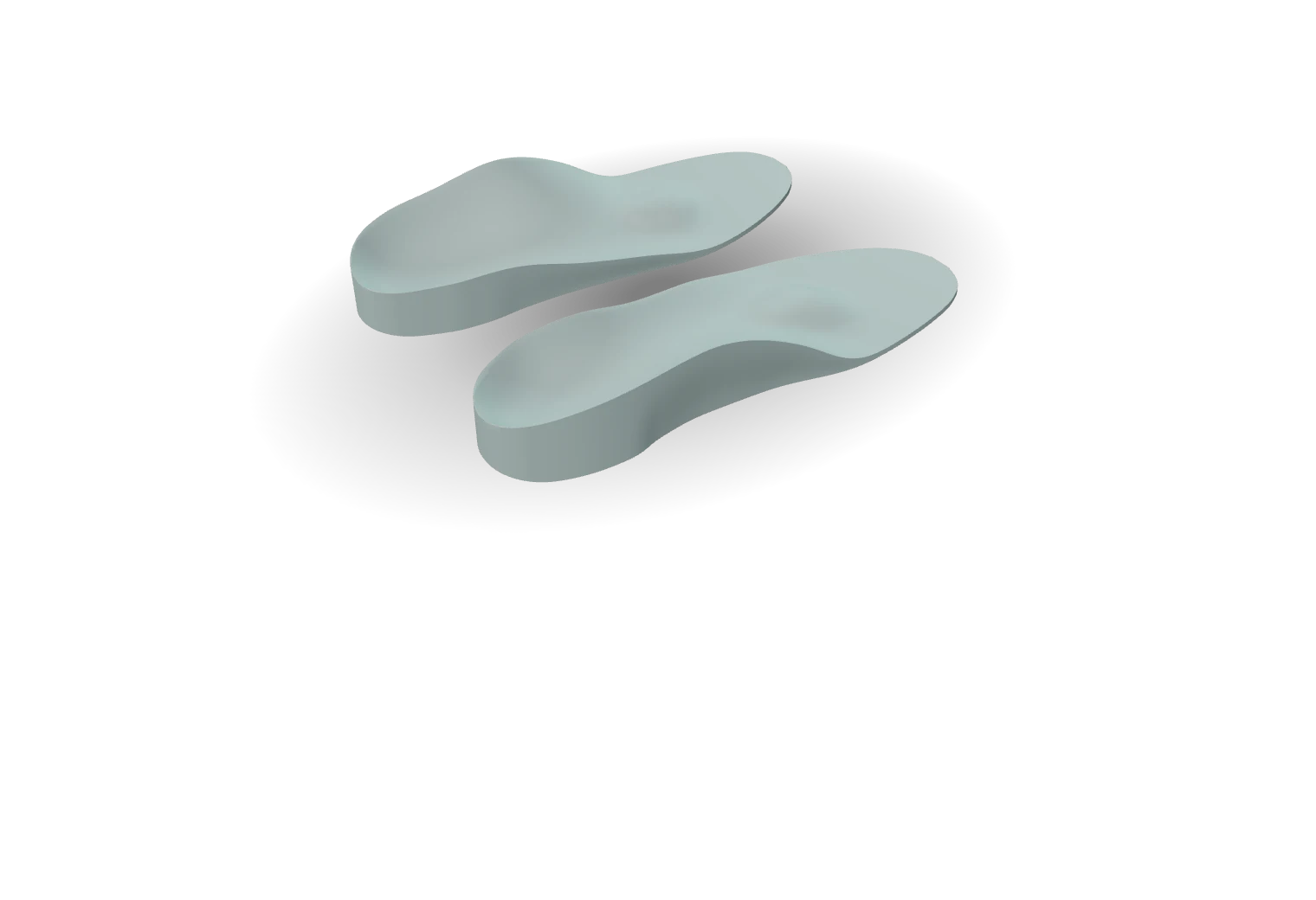
A pair from the prescription, rebuilt while you move a control.
A named starting point.
Size, weight, pathology and side choose one of seven clinical presets, resolved into 44 parameters the practitioner can edit.
Arch height.
In millimetres, the same step at every size. The surface that moved glows, then settles.
Heel cup.
The depth of the cup around the heel, per foot.
Metatarsal pad.
Raised under the forefoot, where the practitioner puts it.
Rearfoot post.
Tilts the seat by a posting angle, in degrees.
The fit gate.
Minimum thickness, wall angle, watertight and manifold are checked before a design can become an order. Left and right are mirrored to 0.0000 mm.
A pressure plate or a 3D foot scan is analysed in memory and never stored. The 3D scan proposes only the measured shape, never a correction.
Release 2.44, running today.
Dutch, English and GermanInterface, proposal sheets, gate messages and export disclaimers
56 automated test suitesFrom mesh topology to the money path, green at release
Hosted since 4 October 2026On a test server; EU servers for European clinics, or a local installation
An owner consoleOrders, pricing, farms and machines, and the money
An assistant that cites its sourcesIt carries out what the practitioner says, and answers from 79 documents
65 patients reproducedFile for file, against the clinic's previous workflow
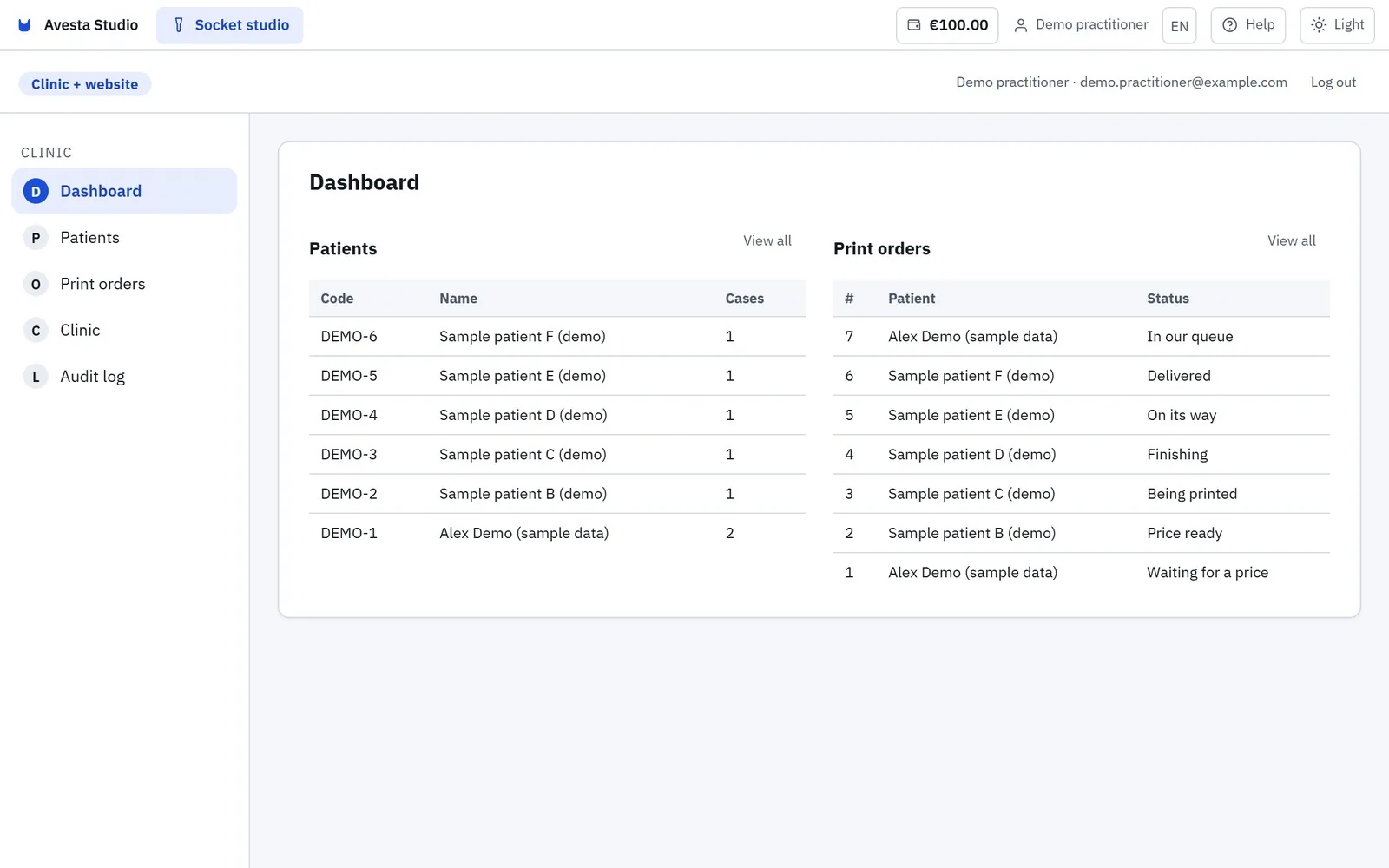
The clinic dashboard: patients, cases and print orders with their status.
Our own machines. Our own farm software.
400+
industrial printers of our own design built and delivered since 2016
190,000+
hours of printing in the company's records
7,700h
completed on the current farm of 26 printers in August 2026
€1,800
a 400 mm machine, installed; a hundred cost less than one industrial SLS system
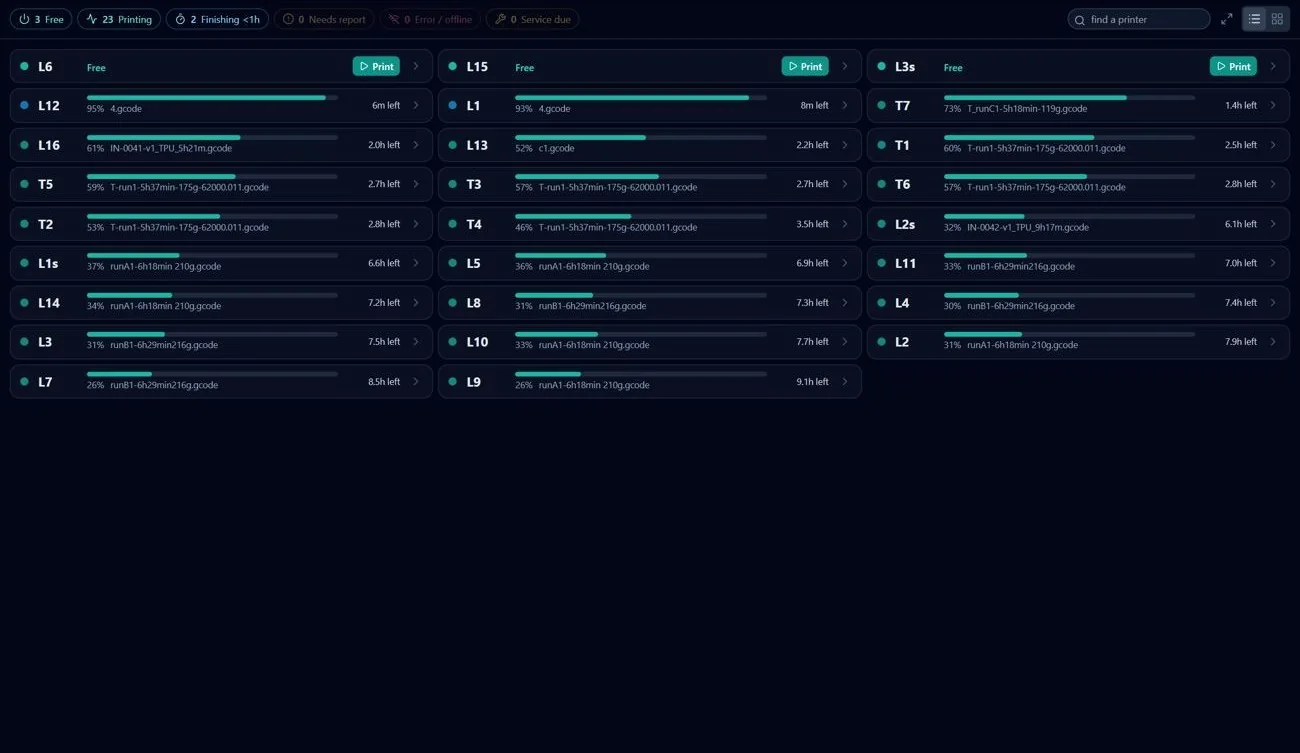
Farm Manager holds one connection to every printer, records every job and every failure with its cause, meters each machine's maintenance, and calls a person only when one is needed. One operator runs thirty machines.
Farm Manager, live on 7 September 2026: 26 printers, every job's progress and remaining time.
Our own extruderOur own mechanism and mechanical designCustomised controller board and firmwareOur own non-planar slicer
380 insole pairs in 70 days.
Pairs in the batchTwo more clinics, first ordersRunning total under the date
4.3h
of machine time a pair, one to three pairs on a plate
1.7%
of machine time lost to failed or cancelled prints in September
Diaco sold them to four clinics in Iran at the local price, about €4 to €9 a pair; 359 are invoiced. Most went to our co-founder's Faramarz clinic and about 50 to the Red Crescent rehabilitation clinic whose O&P section he runs. It proves production and clinical use, not a European price.
One socket, worn daily since June 2026.
470 g in its latest version, against an estimated 670 g for a carbon laminate. It carried the ISO 10328 P6 load level in an informal test; the accredited test runs in year one. Three more are in production for the Red Crescent clinic.
The Netherlands first, then North Rhine-Westphalia.
3,300
lower-limb amputations a year, about half of them transtibial
130
orthopaedic technology companies
1,700
podotherapy practice locations, 900 of them outside the two chains
€438m
orthopaedic devices market in 2025, growing 3 per cent a year
16,943
major lower-limb amputations in 2023, five times the Dutch number
2,486
orthopaedic technology companies
5,387
Sanitätshäuser, the medical supply shops
2h
from Eindhoven to North Rhine-Westphalia, where farm three opens in year three
First customers: the independents.
Podotherapy practices outside the chains and independent O&P workshops. No laboratory of their own, a one-week decision, and the person who tries the software is the one who signs.
Europe: prosthetics and orthotics, USD 2.1 billion in 2025, growing about 4 per cent a year. Sources: Dutch amputation guideline (2020), NVOS-Orthobanda (2021), ZorgkaartNederland (2026), Statista (2025), Ärzteblatt (2025), CompanyData (2026), Grand View Research (2025).
Insoles bring the clinic in. Sockets carry the margin.
Per part
Price
Contribution
Margin
Machine hours
Insole pair
€52
€32.70
63%
4.5
Definitive socket
€390
€286
73%
12
Check socket
€120
€73
61%
6
Year-one average prices, after material, energy, packaging, shipping, labour, depreciation and the site. A machine-hour on a socket earns about three times a machine-hour on an insole.
247.5h
productive hours a machine-month: 12 hours a day at 75 per cent. Our insole machines ran 7 to 9 hours a day in September, limited by orders.
Independents first, with a free month.
M7 to M9
Pilot
Five practices and workshops. The software set up in an afternoon, the team trained, insoles and check sockets made free.
Each pilot
Prove
A pilot passes on written criteria, set before it starts, and yields a case note either way.
M10 to M12
Convert
Three of five pilots convert. Seven to nine paying clinics by month 12, and the first definitive sockets.
Years 2 and 3
Grow
Five new clinics a month in year two, ten in year three. Chains in phase two, through licensed farms.
8of 10
pairs accepted without a re-print
3working days
at most, for every parcel; and the practitioner signs the manufacturing agreement
3of 5
pilots converting to paying clinics in M10 to M12, the plan's target
Where first
Brabant and Limburg, a day's drive from the farm, then the Randstad. For sockets, rehabilitation workshops such as Rijndam, De Hoogstraat and Roessingh.
How we reach them
A Dutch clinical sales lead hired before the pilots and a Dutch clinical adviser; NVvP and ISPO-NL meetings; OTWorld in year two.
Built for the MDR from the first line.
The software
Our documented position: class I medical device software under Rule 11.
A written classification opinion before the pilots; the declaration, EUDAMED registration and a PRRC before any clinic uses it.
It proposes no clinical value. The wall is typed by the prosthetist; every export says approval is the practitioner's.
The part
A custom-made device. The clinic stays the manufacturer and issues the Annex XIII statement.
We fabricate to its approved design under a written agreement, the central-fabrication model of European O&P.
Definitive sockets only after the accredited ISO 10328 report. Check sockets from the farm's opening.
Patient data
Servers in the EU. The clinic controls the record; we process it under a data-processing agreement.
A data protection impact assessment and a security review before the pilots.
With a local installation the record stays on the clinic's computer, and only an order leaves it.
The base case.Self-declared before the first pilot: €45k of regulatory work in year one, ISO 13485 certification in year two.
The software waits for a notified body.Clinics design in the CAD they use today and send us files; the farms keep manufacturing under the same agreement. About a year and the certification cost are added.
EBITDA positive in year three.
RevenueEBITDAEBITDA below zero
At year end
Year 1
Year 2
Year 3
Paying clinics
7
67
187
Machines
12
30
100
Revenue, €
11,400
602,217
2,316,066
After the pre-seed, cash stays at about two months of operating cost at its lowest: about €99k, in month 15, just before the seed.
At half the clinic rate, cash stays positive and break-even moves into year four.
Base case of the financial model, all inputs on one sheet. Year one runs from arrival (M1) to M12, with farm one open in M7.
€600k pre-seed, closing by month four.
Farm one: twelve machines in Eindhoven, built with their CE declaration.
The team: the three founders, a Dutch clinical sales lead and a farm operator.
The regulatory start: classification opinion, technical file, accredited ISO 10328 test.
Five free pilots with written success criteria.
M1€40kOmid Ghazi, as equity and a founder loan
By M4€600kPre-seed
M16€0.9-1.0mSeed, for farm two and the scale-up
2029€3-5mSeries A, for the European farm network
Alongside: WBSO at the 50 per cent starter rate on R&D wages; Vroegefasefinanciering through the Brabant Startup Fonds, convertible loans of €50k to €350k against an investor's letter of intent.
€1.55mpre-seed and seed
Team through year two, net of WBSO52%
Hosting, security, working capital, contingency18%
Sales, marketing, pilots, Germany11%
Regulatory, quality and legal10%
Farms and machines9%
Every date is a month counted from arrival.
Oct-Dec 2026
Facilitator agreement; the BV incorporated; the IND application filed; the cranial helmet added after its clinical test.
M1-M3
Business account, facilitator programme, classification and legal opinions, the pre-seed.
M4-M6
Farm one built with its CE declaration; the class I declaration signed; the sales lead hired.
M7-M9
Five free pilots with insoles and check sockets; the accredited ISO 10328 test.
M10-M12
Seven to nine paying clinics; the ISO 10328 report; the first definitive sockets.
M13-M18
The seed round; a second Dutch farm; ISO 13485 under way.
M19-M36
About 190 clinics; a farm in North Rhine-Westphalia; the first licensed regional farm.
Checkpoints the facilitator and the IND can verify
M4
Pre-seed closed
M6
Class I declaration signed, before any clinic uses the software
M9
Five pilots run, each with a written case note
M12
Seven to nine paying clinics; self-employed permit applied for
Arrival (M1) is planned for the second quarter of 2027. Counting in months from arrival keeps the plan valid if the permit decision moves by a few weeks.
Three founders: machines, clinic, operations.
Omid Ghazi
Co-founder, chief executive and chief technology officer
Chemical engineer; designing and building industrial 3D printers since 2014.
Founded Diaco in 2016: more than 400 industrial machines delivered, production farms of up to 30 machines, more than 1,500 production projects for some 30 companies and 12 universities.
Wrote Farm Manager, PrintFlow and Avesta Studio; developed the foamed carbon-fibre polyamide process and the layer-direction slicing strategy.
The three founders move to Eindhoven with their families and run Avesta Care full time.
Reza Khodakarim, chief clinical officer
Orthotist and prosthetist. Founded the Faramarz clinic in Shiraz in 2017, which fits our insoles and socket, and has run the O&P section of the Red Crescent rehabilitation clinic there since 2019.
Sajjad Seyedzadeh, chief operating officer
Founded the Nafis mattress factory in 2016 and grew it to 20 employees under five team leaders: production, purchasing, delivery and finance.
A Dutch clinical adviser
A prosthetist or podotherapist of standing, on board before the pre-seed: the Dutch clinical terms, the first pilot doors, the advisory board.
 Drag to turn